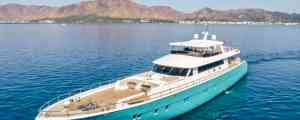
Pick Turkey when space, group size, calm water, and value per euro are driving the decision: a typical crewed charter there books at €30,000 to €70,000 for the week, and it is the one major Mediterranean market where a single yacht can legally carry more than 12 guests. Pick Greece when the trip is built around the marquee islands or a top-tier motor yacht: most of our Greek clients book between €100,000 and €250,000, and no other fleet in the Med is as deep at that level. We broker crewed charters in both countries, so this is the honest version of how we route clients, not a pitch for either coast.
- A typical Turkish charter week runs €30,000 to €70,000; a typical Greek booking with us runs €100,000 to €250,000.
- Turkish-flag yachts can carry more than 12 guests in Turkish waters. In Greece the cap is 12, full stop.
- The Turkish coast is sheltered, with short 1 to 3 hour hops. The Greek Cyclades are windier and more open, which is manageable, but it takes planning.
- You can combine both countries in one charter, but the yacht must start and end in Turkey, and we only recommend it on 10 days or more.
Everything here is about private crewed charters: the whole yacht, your group only, with a professional crew. If you have seen "Blue Cruise from $500 per person" offers online, that is a different product (a shared cabin cruise), and it is not what we arrange.
The Short Answer, by Group
- Multi-family groups and anyone with more than 12 guests: Turkey. A gulet gives you the most deck space and cabins per euro in the Mediterranean, and Turkish law lets one yacht carry your whole group. In Greece, 14 people means 2 yachts.
- Couples and friends set on Mykonos, Santorini, or Hydra: Greece. Those islands only exist there, and Turkey is not a discount substitute for them. If the dream is specifically Greek, charter Greece.
- A first luxury charter at €30,000 to €70,000: Turkey. That budget books the top of the Turkish market. In Greece it books the entry and middle of the market, which is still a good week, but you feel the difference.
- Motor-yacht clients from €100,000 up: Greece. This is where the Greek fleet has no real rival in the eastern Med, in both depth and choice.
- Groups who do not want to think about weather at all: Turkey, or the Greek Ionian. The Turkish coast is the no-thought option; in Greece we simply route around the wind for you, most reliably in the Ionian and Saronic.
What a Week Actually Costs in Each
In Turkey, crewed gulets start around €25,000 to €35,000 for the week, quality motor yachts from about €50,000 to €70,000, and most of our Turkish charters land between €30,000 and €70,000. In Greece, catamarans start around €30,000 and motor yachts around €60,000, but what most of our Greek clients actually book is €100,000 to €250,000, because that is where the yachts that justify a Greek charter live. For the full Turkish breakdown by yacht type, see our Turkey yacht charter prices guide.
Tax is where most comparison articles get it wrong, so here are the current figures. Turkey charges 20% VAT on the charter fee, and has since July 2023. Greece charges 13% on crewed charters (fixed in law since December 2023), and most crewed yachts qualify for a reduced effective rate of roughly 5% to 8%, depending on the yacht’s certification and route; your written quote states the exact rate. Read that again if you assumed Turkey was the cheap option across the board: on the tax line alone, Greece usually costs less. Turkey wins on what the charter fee itself buys, not on the tax.
The running costs are structured differently too, and this catches people. Greek charters are almost always "plus expenses": you pay an Advance Provisioning Allowance of 25 to 30% on top of the fee, which covers fuel, food, drinks, and mooring, and you get the receipts. Turkish gulets often work the other way: crew, around 4 engine hours a day, and mooring are bundled into the fee, and food is a fixed per-person board package instead of an open allowance. One definition worth knowing before you compare quotes: halfboard means breakfast, lunch, daytime snacks, and up to 2 dinners aboard per week. That is not a cost cut. Evenings ashore in harbor restaurants are one of the best parts of a Turkish week, and the package is built around them.
The Boats Are Different Animals
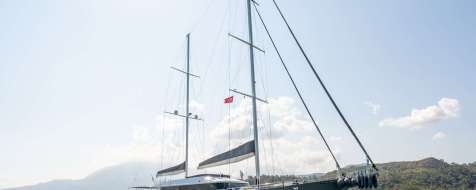
The gulet is the signature Turkish product, and there is nothing like it in Greece. It is a broad wooden motorsailer built for exactly this coast: huge aft deck for long dinners, cushioned foredeck, 5 to 8 cabins, and a crew whose whole working culture is hosting groups. Per euro, nothing in the Mediterranean gives a group more living space. We will be straight about the tradeoff: a gulet is not Riviera finish, and a client expecting lacquered superyacht interiors will notice. What you get instead is space, shade, and a crew that runs the week around your group. Many of the best gulets are older hulls that are rebuilt and refitted constantly, and some of our favorite boats in the country are exactly that. Start with our gulet charter guide if this is the direction you are leaning. You will also see the week called a Blue Cruise, the traditional Turkish name for it; on our charters that always means a private yacht, and our Blue Cruise guide explains the term properly.
Turkey’s motor-yacht side is the part most clients have not heard about. The country is now one of the world’s largest yacht-building nations, and we are seeing new, competitively priced motor yachts enter the Turkish charter market every season. There are peak weeks when we cannot find an available motor yacht in Greece and the Turkish calendars are still open, and Turkish owners tend to respond quickly to offers.
Greece’s answer is depth. Catamarans, motor yachts, and crewed sailing yachts in numbers Turkey cannot match, especially from €100,000 up. If you want a specific style of boat, a specific week, and a shortlist of genuine alternatives, Greece gives us the most to work with of any market we book.
Seas, Winds, and How Far You Actually Cruise
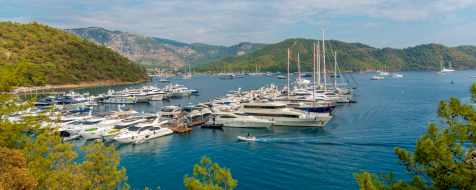
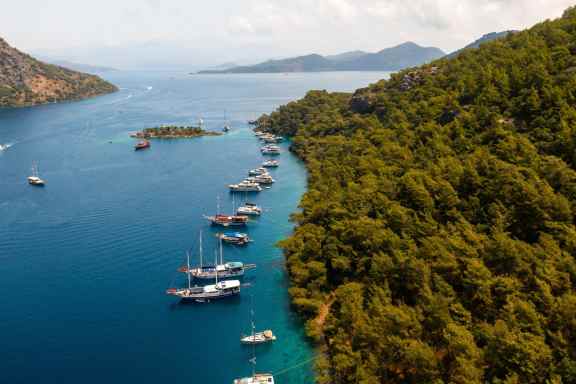
The Turkish Turquoise Coast is one long chain of sheltered gulfs and bays, and the classic routes out of Göcek, Bodrum, and Fethiye move in short 1 to 3 hour hops. That matches how we plan every charter anyway (2 to 3 hours of cruising a day at most, because you came for the coast, not the transit), and it is why Turkey is our default answer for guests who are nervous about seasickness or chartering with small children.
The Greek Cyclades are a different sea. The meltemi wind blows hardest in July and August, and the legs between the famous islands are open water. This is completely manageable: we route Cyclades charters around the forecast, a faster motor yacht changes the math entirely, and Greece has genuinely calm alternatives in the Ionian and the Saronic. But if you want a week where weather never enters your head, the sheltered Turkish coast is the simpler yes. Timing matters in Turkey too, and September is one of the best-kept answers; our best time to charter in Turkey guide covers the months properly.
More Than 12 Guests: the Rule That Decides It for Big Groups
Here is the legal fact that settles more Turkey-or-Greece decisions than any brochure comparison: charter yachts in EU waters, including all of Greece, are capped at 12 guests. Turkish-flag yachts in Turkish waters are not, and plenty of large gulets are licensed for 14 or 16. The moment that same yacht leaves Turkish waters, the cap drops back to 12.
The consequence for a 3-generation family of 14 is simple. In Turkey, everyone shares one yacht, one dinner table, one anchorage. In Greece, the same group needs 2 yachts cruising in tandem, which works, and we arrange it, but it splits the group and usually costs more. This single rule is why so many of our largest charters run out of Bodrum and Göcek. The licensing, the real 14 to 36 guest yachts, and the costs are all in our guide to chartering a yacht for more than 12 guests in Turkey.
2 smaller Turkish outliers worth knowing while we are on rules: Turkey is the only major Med market where guests need no license to drive the jet skis, and crews on Turkish-flag yachts are Turkish by law, which in practice means crews who have worked this exact coastline their whole careers.
Can You Do Both in One Trip? Yes, With 3 Rules
This is the most common follow-up question we get, and the honest answer is: possible, sometimes wonderful, and more constrained than the map suggests.
Rule 1: start and end in Turkey. Charters on Turkey-based yachts that cross to the Greek islands have to come back and finish in Turkey. A one-way Bodrum-to-Athens charter on a Turkish yacht is not a thing, and very few yachts (EU-flagged, commercially registered) can charter freely in both countries at all.
Rule 2: budget the border, in time and money. Clearing customs takes about half a day out and half a day back in, and the Greek side adds real fees (cruising tax, customs and agency charges, island landing fees). These charges apply once per crossing, so the route should cross once, not bounce between coasts. Cross-border taxes also change at short notice, which is why we quote them conservatively and re-confirm everything before the charter.
Rule 3: only do it with 10 days or more. On a 7-day charter, the border eats the best part of 2 days, and you feel it.


Broker insight
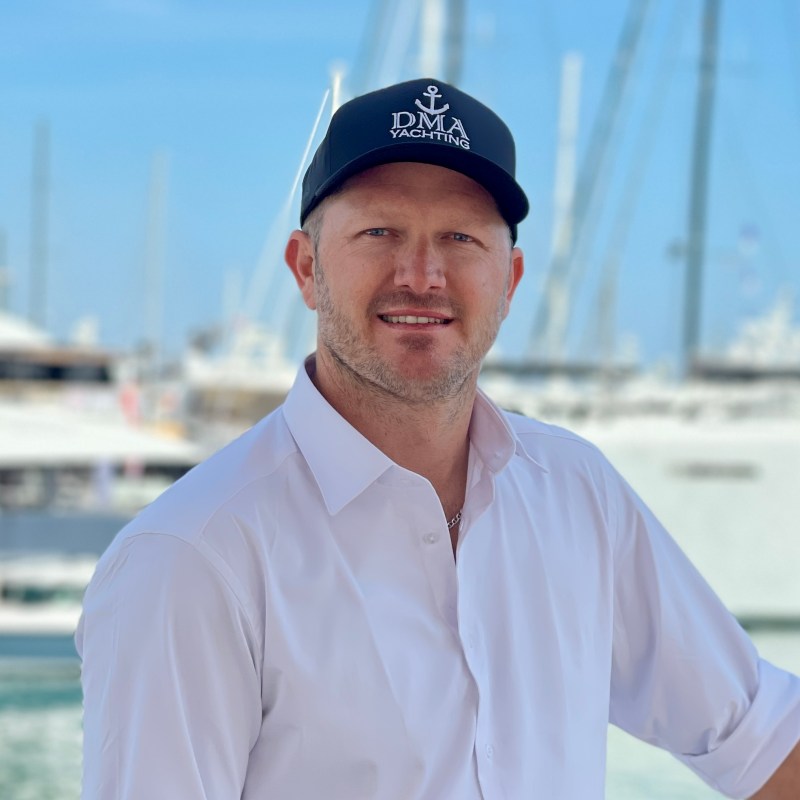
Clients ask us all the time to start in Turkey and head over to Greece. I would only recommend it on 10 days or 2 weeks. Clearing customs takes about half a day in and half a day out, so on a 1-week charter you are giving up the best part of a day each way just to move the boat between countries.
 Daniel Asmus
Owner, Charter Broker, Active CYBA Member, IYBA, ECPY
Daniel Asmus
Owner, Charter Broker, Active CYBA Member, IYBA, ECPY
If the Dodecanese matter to you (Rhodes, Symi, Kos are close enough to see from the Turkish coast), the combination is worth those constraints, and our guide to visiting the Greek islands on a Turkey yacht charter covers the routes and paperwork in detail. And when a group wants 2 full weeks moving freely between both countries, the version that usually works better is a week in Turkey and a week in Greece on 2 separate yachts: no border paperwork eating charter days, and each yacht fully legal in its own waters.
When Greece Is the Right Call, Honestly
We sell both countries, so we have no reason to talk you out of Greece, and for many groups it is simply the right answer. Choose Greece when the trip is built around places only Greece has: Mykonos and Santorini, Hydra’s harbor, the Ionian’s green channels. Choose it when you want the widest possible shortlist of premium motor yachts and catamarans, or a one-way route (Athens to Santorini is a classic that has no Turkish equivalent, since Turkish charters run round trips). And remember the tax line: with Greek charter VAT effectively around 5% to 8% for most crewed yachts against Turkey’s 20%, a Greek quote can close more of the headline price gap than people expect.
The way we would put it in one sentence: Turkey is the space, calm-water, and value answer; Greece is the icon-islands and top-tier-fleet answer; and neither is a compromise if it matches what your group actually wants. Tell us the group size, the dates, and which country is pulling you, and we will tell you straight which one we would book for you, because we book both.
People also ask
Is a yacht charter cheaper in Turkey or Greece?
For the same size of group, Turkey usually costs less: a typical crewed Turkish charter books at €30,000 to €70,000 for the week, while most of our Greek clients book €100,000 to €250,000. The gap narrows on tax, though: Turkey adds 20% VAT, while Greek crewed charters are usually invoiced at an effective 5% to 8%.
Can you charter a yacht in Turkey and visit the Greek islands?
Yes. The charter must start and end in Turkey, customs takes about half a day each way, and Greek-side fees apply, so we only recommend it on charters of 10 days or more. The nearby Dodecanese islands (Rhodes, Symi, Kos) are the ones worth crossing for.
Which country is better for a group of more than 12 guests?
Turkey. Turkish-flag yachts can legally carry more than 12 guests in Turkish waters, so one large gulet can take 14 or 16 people; in Greece the limit is 12 per yacht, which means chartering 2 yachts in tandem.






 iMessage
 WhatsApp