By Klara Braga Jakobsen, Yacht Reviewer at DMA Yachting · Last updated: October 2026
A gulet is a wooden, two-masted motor sailer built in Turkey. She is chartered with her crew included and almost always booked as a whole boat for a week.
The shape comes from the working boats of the Bodrum and Bozburun coast. The modern charter version keeps the hull and the rig, and puts 4 to 8 en suite cabins and a very large shaded deck on top.
- Wooden hull, 2 masts, built almost entirely on the Turkish coast around Bodrum and Bozburun.
- Across the 22 gulets we list in Turkey the middle boat is 113 feet, 12 guests, 5 cabins.
- Crew is included in the rate, not an extra, and so is fuel for a set number of cruising hours a day.
- Low-season weeks start around 17,500 euros and the middle of our Turkish fleet sits near 27,500.
- She motors most of the time. The sails come out when the wind and the route allow it.
If you only want the practical version: a gulet is the most boat for the money in the Mediterranean, and Turkey is where they live. Our gulet charter in Turkey page handles choosing and booking one. This article answers the question underneath it, which is what the boat actually is.
Where the Gulet Comes From
The gulet began as a working hull on the south-west Turkish coast, carrying sponges, fish and cargo between Bodrum, Bozburun and the islands. When tourism arrived the same yards kept building the same hull and fitted cabins into it instead of cargo holds.
That history is why the boats are still built where they are. Of the gulets we list in Turkey, the yards named on their own records sit in Bodrum, Bozburun, Tuzla and Antalya, alongside named builders such as Mastori, Mengi-Yay and Turkyacht.
There is no gulet factory and no series production. Each one is a custom boat, which is also why no 2 layouts are quite the same.

What Makes a Boat a Gulet
Four things, and a boat needs all four before the word applies.
- A wooden hull. Usually mahogany or pine on an oak frame. A steel or fiberglass boat of the same shape is a copy of a gulet, not one.
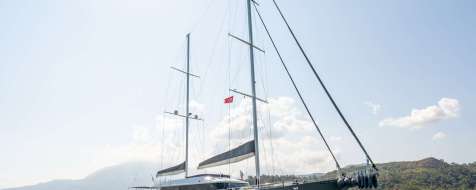
- Two masts. Normally ketch or schooner rigged, with the shorter mast aft. This is the silhouette people recognize.
- A rounded aft end and a long, flat deck. The deck is the point: a gulet gives you more usable outdoor space per euro than anything else afloat.
- Engines that do the work. A charter gulet is a motor sailer. She is designed to motor between bays and sail when it suits, not the other way round.
Boats that look the part but are built in steel or GRP are usually described as motor sailers rather than gulets, and the brochures are not always careful about the difference. We say which it is in writing before you book.
How Big Is a Gulet, and How Many People Fit
The 22 gulets on our Turkish list run from 79 to 145 feet, and the middle boat is 113 feet. Cabins run 4 to 10, with 5 the most common count, and guest numbers run 8 to 20 with 12 the most common.
Twelve is not a coincidence. A commercially registered yacht carries a maximum of 12 guests overnight, infants included, and most gulets are built to fill exactly that. Boats advertised for more than 12 are carrying a different licence, and they are a separate conversation.
Our best gulets for 12 guests page covers the boats built right at that limit, and the full ranked list is in our top 10 gulets for charter in Turkey.
Why the Crew Comes With the Boat
A bareboat gulet is not a thing. The boats are wooden, hand-built and individually quirky, and the owners crew them themselves or employ the same people year after year. A standard gulet crew is 4 to 7 people on a 30-meter boat: captain, engineer, chef, and 1 or 2 deck and service crew.
For a guest that ratio is the quiet luxury of the format. It is also why the rate reads low against a motor yacht of the same length: on a gulet the crew is already inside the number.
What a Gulet Week Costs
Low-season weeks on our Turkish gulets start at about 17,500 euros and the middle of the fleet sits near 27,500. July and August run roughly 20 to 40 percent above that, and the largest and newest boats reach 130,000 to 150,000.
What the base rate buys is the main thing that separates a gulet quote from a Greek or Italian one. It normally covers the yacht, the whole crew, fuel within a daily cruising-hours allowance, and mooring in Turkish waters.
Food and drink come as a board package priced per person per day rather than through an advance provisioning allowance. Turkish VAT of 20 percent goes on top.
The full breakdown, including how the engine-hour allowance works, is in our guide to what is included in a Turkish gulet charter.
Who a Gulet Suits, and Who It Does Not
A gulet is the right boat for a group of 8 to 12 who want deck space, shade and long lunches, and who are relaxed about pace. Families and multigenerational groups do well on them because the deck is big enough that nobody has to sit with anybody.
It is the wrong boat if you want speed, long distances in a week, or a modern motor-yacht interior. Gulet cabins are comfortable and compact rather than grand, and the boat cruises at 8 to 10 knots.
Our gulet vs motor yacht comparison takes that choice apart properly.
Gulet, Blue Cruise or Cabin Charter
Three words get used as if they mean the same thing. They do not.
- Gulet is the boat.
- Blue cruise is the trip: the traditional Turkish coastal route a gulet usually sails.
- Cabin charter is a booking method, where you buy 1 cabin and share the boat with strangers.
Everything we book is the whole boat for your group alone. Our blue cruise page explains the route, and if you came here from a per-person price, that is a cabin charter and a different product.
Where a Gulet Charter Starts
Bodrum is the main base and the historic home of the boats. Göcek, Marmaris and Fethiye cover the south, and Bozburun is the quiet gulet capital for groups who want fewer boats around them.
A gulet can also cross to the Greek Dodecanese, which is one of the format’s best tricks: Kos, Kalymnos and Leros are a short hop from Bodrum, and the paperwork for the crossing is routine. Our Bodrum, Göcek, Marmaris or Fethiye comparison walks through the bases.
People also ask
Is a gulet a sailing boat or a motor yacht?
Both, and in practice mostly a motor yacht. She carries 2 masts and real sails, and uses her engines for most of the week because Turkish routes are short hops between bays. If sailing is the point of your trip, say so when you inquire and we will shortlist the gulets whose crews sail them.
How many cabins does a gulet have?
Four to 10 across our Turkish fleet, with 5 the most common and 6 close behind, and every cabin en suite. Because each gulet is a custom build, the cabins inside one boat are often less equal than the count suggests, so we send the bed table rather than the brochure number.
Do gulets have air conditioning?
Yes, on everything we charter. The question worth asking is not whether a gulet has air conditioning but whether the generator runs all night to power it, because that is what you hear in a wooden hull. We check the overnight generator arrangement on any boat we propose.
Are gulets old boats?
Not generally. The 22 gulets we list in Turkey were built between 1995 and 2022, the middle one in 2009, and 10 of them are 2010 or newer. The hull shape is traditional; the boats themselves are mostly modern, and several are refitted far more recently than their build year suggests.
Can you charter a gulet outside Turkey?
Yes. Gulets work Croatia, Greece and Montenegro as well, and a Turkish-flagged gulet can take guests to the Greek islands from Bodrum. Turkey remains where the fleet is built, based and cheapest, which is why most gulet charters still start there.
Is a gulet good value compared with a catamaran?
For deck space and crew, yes, comfortably. A 113-foot gulet with 5 cabins, 12 guests and 5 crew sits in the same money as a 60-foot catamaran with 4 cabins and 2 or 3 crew. The catamaran gives you shallower draft, newer interiors and more speed; the gulet gives you space, shade and service.







 iMessage
 WhatsApp